Up-Link Operator


In September 2005, I had been unemployed for a year. Hurricane Katrina hit New Orleans, and many people were evacuated to the Astrodome in Houston, Texas. I got a call from an old friend asking me if I was available for freelance work as an uplink operator for the Associated Press. This was the first job offer I had had in over a year, so I jumped on it. I was on my way to the Astrodome within the hour with a backpack full of clothes since I did not know when I would be home again. I made my way through the heavy traffic that led into the Dome parking lot and found my way to “Satellite City”. This is where all the satellite uplink trucks, along with the microwave trucks, were parked to distribute the News worldwide. I found my truck and went to work.
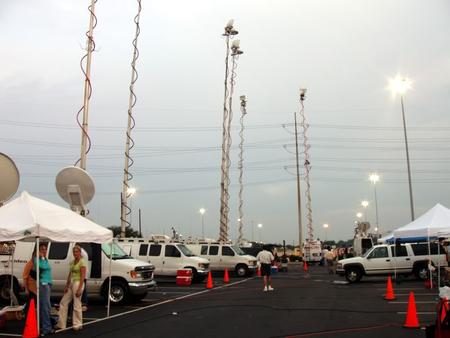
The truck we had was actually an old production truck that we were connected to fiber that led directly to the Associated Press uplink dishes in Dallas, Texas. We had a tent set up behind the truck with broadcast production gear, a camera, and an audio mixing setup that we encoded for uplink. Our job was to assist clients and news crews who needed to send their audio/video signals to their companies. We also provided Live camera feeds so they could broadcast live reports. We would get a call from the AP letting us know who had bought time and what they wanted to do, like use our broadcast equipment, use theirs live, or uplink to be recorded at their company. We would set up for what the job was.
In most cases, they had a reporter stand in front of our camera and talk live on their newscast. Sometimes we ran the camera; other times they had their own camera guy who ran our camera or hooked up their camera to our system. We worked around the clock since we were up-linking all over the world. I recall one evening when we got a call that our next uplink was the BBC Breakfast Show. We thought, ‘great, maybe we can get some decent sleep’. We were then reminded that it was for breakfast in London, which is about 1:00 am our time. That seemed to be the typical day.
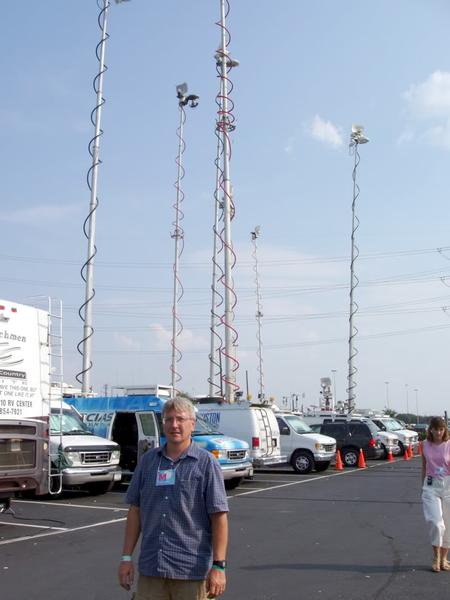
Me in Satellite City
In front of our truck, we had installed an electrical power breaker box at a light pole to run our truck and broadcast systems. Almost all other trucks ran off their generators all the time. When the Fox News truck pulled in next to us, they asked if they could tap into our power. My co-worker asked what we could get in return. The Fox Engineer said they have direct satellite Internet and Wi-Fi, and that he would give us the password. It was a deal! Several days later, we lost Internet connectivity, so my co-worker was walking over to the power distribution to unplug the Fox truck. The Fox Engineer saw him going over there and ran out to stop him. The Engineer said they had to change the password because CNN had discovered it and was using their Internet. We got the new password and had to swear not to share it with CNN.
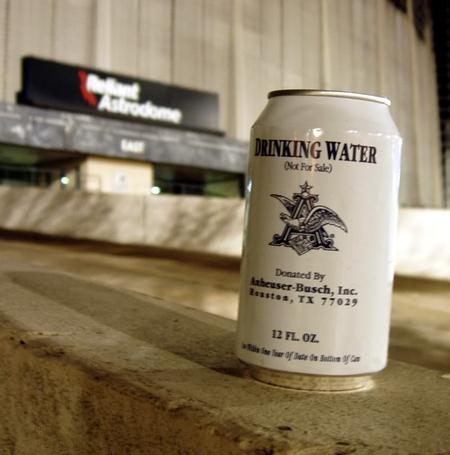
Near our area was what looked like a large watering trough. People would come by from time to time and fill it with ice and drinks. There were all kinds of things to drink, except for alcohol. Whatever we wanted, we would get. I got mostly water. Also, golf carts carrying stacks of pizza boxes, along with other food, would stop by. In the mornings, they brought boxes of doughnuts. I thought it was funny that when the doughnuts came through, the police did too. We had to be quick to grab some doughnuts.
As the days went on, the Astrodome site became more crowded. It turned into a city unto itself. There were around-the-clock police patrols that came from all over the country. Some were on horseback, others walked or used cars and golf carts. There was the constant noise of helicopters overhead, both News and Police, that never stopped.
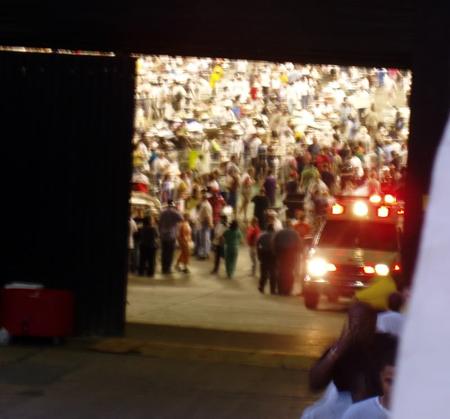
This picture is looking inside the Astrodome.
I did not go inside.
Free drinking water
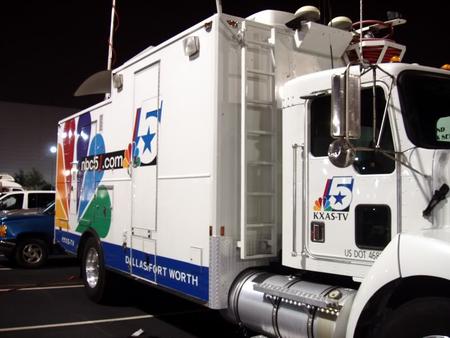
One of the up-link trucks
I was able to go home about every third day to shower, get some clean clothes, and head right back. We lived in the parking lot. Some nights I slept a few hours at a time in our van; other nights I rolled out a sleeping bag in the center aisle of the TV truck.
For the first few days, there were four of us who crewed the truck and the production tent. One day, we got a call that the AP wanted to trim the crew down to two. I survived the cut.
On one side of us was a local news outlet. The other side of us was Fox News. CNN was on the other side of Fox, with ABC, NBC, and CBS down the line. We got to meet all the people we see every day on those networks. I enjoyed watching Fox go live with Greta Van Susteren each evening. She is a very short person, maybe just over 5 feet nothing. Very nice person. Her sister was her producer for the show and was also a very nice person. One evening, Greta was on live. I called my Mom and asked her to switch to the Fox News Channel. She did. I asked if she saw Greta or if it was in a commercial. She said it just came out of a commercial. I told her to watch the background behind Greta. I then walked past and looked at the camera. Instantly, I heard Mom, over my cell phone, exclaim that she saw me. She then called out to my Dad to hurry up and see this. When Dad got in the room, I walked the other direction. It was fun to have my parents watch me on Live TV! Greta’s sister, the producer, then asked me not to do that again. It was all fun!
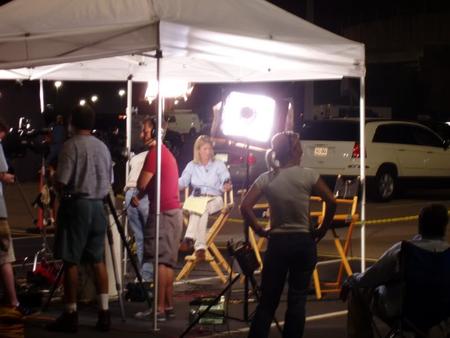
This is the Fox News set with Greta Van Susteren. Her Producer is the young lady with the ponytail.
The big shock-and-eye-opener for me was how the different News agencies spun the News their own way. One day, my co-worker and I were walking past the CNN area, and a producer came out and asked me if I had ever been to the White House. I said I had not. My co-worker said he took a tour a few years ago. The producer wrote something down on a clipboard, walked over, and handed it to the lady in front of the camera. Curiosity got the better of us, so we moved closer to see what was going on. The red light on top of the camera came on and the first thing the reporter said was; “According to White House sources…..” I could not believe what I just witnessed. Remember that George W. Bush was President at the time, and some of these News agencies were not very complimentary to him. Another time, President Bush made a live broadcast talking about the hurricane damage and what was happening at the Astrodome with the evacuees. The ABC truck had a small audience, showing the press conference on two large-screen TVs. They invited several residents to watch the broadcast, then went live with that audience and asked them what they thought of the press release and the overall situation in the hurricane aftermath. For the most part, the audience was complimentary of President Bush. The ABC people who were hosting this broadcast tried to word their questions to provoke a controversial response. When the audience was not cooperating but was complimentary toward the President, they went to a commercial, and several in the audience were removed, while others who were briefed on what to say took their seats. ABC finally got what they wanted with the answers that were negative towards the President. Watching this made me think that this level of News has become Tabloid TV.
From day to day, we did not know who would stop by, take a seat, and start talking. One hot day, a guy stopped by, asked who we uplinked, and made small talk. He asked if we had any water. I said there was plenty of water in the trough next to my van. He got up to get a bottle of water, so I got up and walked over there too. I sat on the rear bumper of my van, and he did the same. We sat on the van's rear bumper, talking until the water was gone. He got up, shook my hand, and walked on away. He said, "Thanks for taking the time to talk. You are easy to talk with." After he left, my coworker asked what he was like to talk to. I asked who that was; he looked familiar. Turns out it was Sean Penn. The funny part of that whole thing was that Sean sat on the van's bumper, underneath the W sticker for GW Bush. I wish I had gotten a picture of that. Another time, a group of serious guys came by and stood just outside our production tent, then a young lady came in and asked if she could talk with me. I opened up a lawn chair for her and brought another for myself. She asked if we had uploaded to Singapore. I said we had. She asked what they said. I said I only understand English, so I had no idea. She laughed and said that she had family there and was just curious. After she left, I found out that she was Elaine Chao, the Secretary of Labor and a Cabinet member.
Nighttime at Satellite City became sort of a Twilight Zone, in that the police would form a barrier around the area, and anyone wanting to go in had to have a Media Pass. All others were turned away. At 11:00 pm, the gates around the parking lot were closed and manned by police. You could leave, but no one would be let back in. One night, I heard something going on at the fence line, and the police had pulled someone off the fence who was trying to climb back in. They did not arrest him, just made sure he left. Another night, a young black man came up to me and started talking, then he started yelling at me. He was venting over the whole situation of having to leave his home in New Orleans and, in his words, ‘being treated like a prisoner’. A couple of police officers started to come my way when they heard the guy yelling. I held up my hand for them to stop, which they did, but they kept watching us closely. After a few minutes of yelling at me, most of which made no sense, he left. One of the officers followed that guy as he walked off, and the other one came over to me. He asked what was going on, and I said he just needed to vent, so I let him. I never did feel threatened, but had a sort of peace knowing an unseen force protected me.
Ever-present Police. We loved having these folks around!
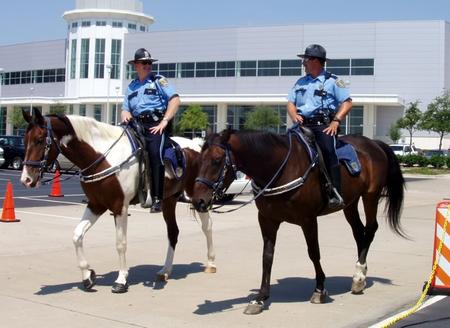
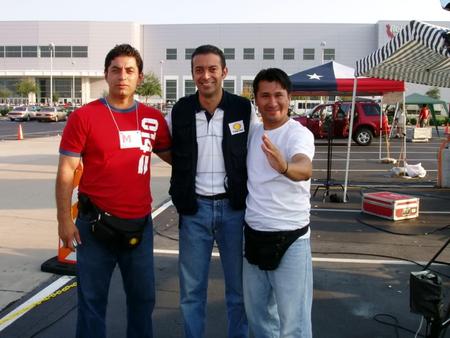
One of the best memories was of the people I worked with, specifically the News Crews and the Camera and Audio guys. I met crews from all over the world and would see them most every day. The crew I worked with the most was the Telemundo crew from Mexico City. The Reporter/Producer spoke fluent English. The Camera and Audio guys did not. The camera guy reminded me of Jackie Chan, so he played that up. I would call him Jackie, and he would then put his hand up like a Karate chop. We could only understand a few words of each other, but we had the best time laughing at things. I would go with these guys to eat breakfast at a nearby Denny’s. They needed to get some things to repair their camera, so I went with them to a Fry’s, a large discount electronics warehouse store. It was funny seeing their reaction as they walked around Fry’s. They had never seen a store like that before. Another crew I recall is a Canadian crew that spoke only French. The last day I saw them, the camera guy gave me his camera headset and a signed tape case. I signed a beta-cam tape case and gave it to him. Funny how you can make good friends and not understand a word they say.
Tele-Mundo Crew from Mexico City. Audio guy on the left, Producer/Reporter in the middle. Cameraman "Jackie Chan" on the right.
Tele-Mundo about to go Live
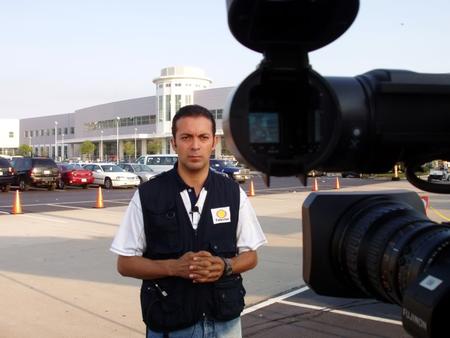
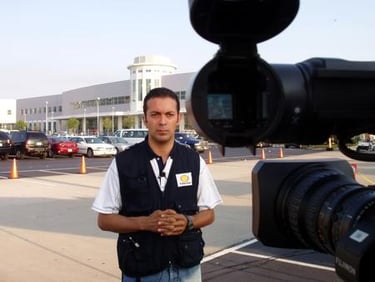
Isreali News up-linking his footage
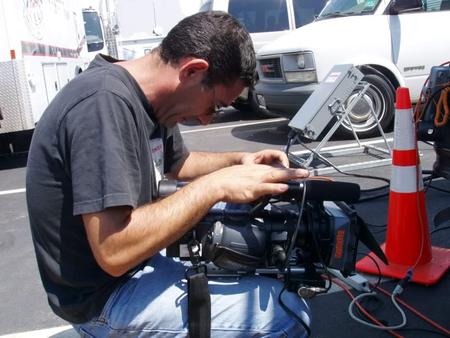
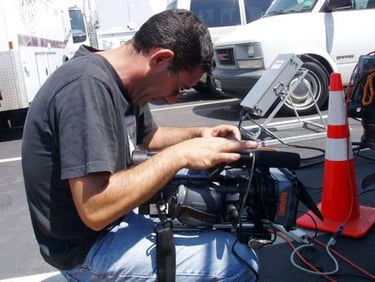
Crew from Barcelona is doing a quick edit before uplinking to Spain.
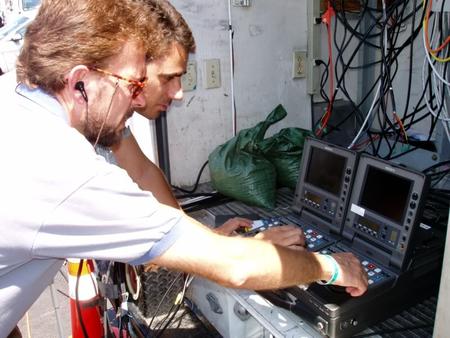
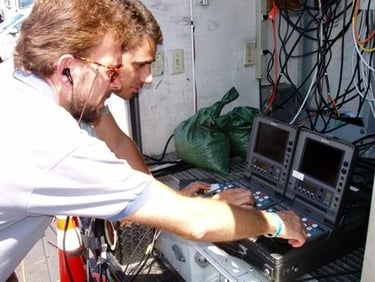
One afternoon, we set up a link for a live broadcast with Argentina. When we set these up, everyone spoke English, so there was no miscommunication, but when the reporter went live, they would speak in their own language. I contacted the AP uplink guy in Dallas; he confirmed our signal, then routed it to a satellite over Panama. We got confirmation there, then another bounce to hit Argentina’s satellite, and then confirmation that the News control room had audio/video. Once we were confirmed in the newsroom, the producer took over the call, which he had on speaker phone so that the Director could overhear. The reporter was running late, and my co-worker was on the phone with her. She was caught in traffic, and it was looking like she was not going to make it. So, to kill time and keep the connection confirmed, the Producer in Argentina asked what my name was. I responded, “Billy.” He then asked where I was from, and I responded that I am from Texas. The producer then said, “What does Billy from Texas look like?” I stepped in front of the camera, and over my headset, I could hear several people in the News control room in Argentina yell out, “Hello, Billy from Texas!” I could not see them, but they saw me in broadcast-quality video. I would have to say that was my fondest memory of working for the Associated Press.
Growing up, I had always wanted to work in Network News, doing exactly what I did for the Associated Press those few weeks. The AP does not report news but only provides an avenue for distribution. I got to experience what I aspired to do and discovered I really enjoyed it, but I know I don’t want to do it full-time. Also, seeing what really goes on with the Major networks as far as spinning the news for their own agenda, whatever that agenda is, I could not be a part of that. No Tabloid TV for me!

Copyright © Bill Overton
All rights reserved.